Why Your Detroit Contracting Business Still Gets Zero Calls from Google Maps
You’ve done everything the “gurus” told you to do. You claimed your Google Business Profile. You uploaded photos of your latest roofing job in Grosse Pointe. You’ve hounded your customers until you reached 50, 75, maybe even 100 five-star reviews. You look at your profile and see a beautiful, optimized page. Then you look at your call log, and it’s a ghost town.
As the founder of RankRight and a specialist in Detroit local SEO, I hear this story every single week. Contractors across Metro Detroit – from plumbers in Royal Oak to HVAC specialists in Downriver – are frustrated because their digital presence feels like a billboard in the middle of the woods. You exist, but nobody is seeing you when they actually need a quote.
The reality is that google maps lead generation has changed. It is no longer a “set it and forget it” directory. It is a living, breathing algorithm that recalculates results for every single searcher based on a complex web of proximity, relevance, and prominence. If you aren’t getting calls, it’s not because people don’t need your services; it’s because Google has decided you aren’t the most relevant answer for the person standing three miles away from your shop.
The Proximity Trap: Why Your Map Pin Stops at the City Line
The most common reason Detroit contractors fail to rank is something I call the “Proximity Trap.” Google’s primary goal is to provide the most convenient solution to the user. Research consistently shows that Maps heavily weights the physical distance between the searcher and the business. In a fragmented region like Metro Detroit, this creates “invisible walls” that kill your lead flow.
I often see contractors who have a physical office in Troy or Southfield wondering why they don’t show up for searches in Detroit proper. The moment a potential customer crosses a major boundary, your visibility can plummet. We’ve documented this specifically in our analysis of why your shop disappears the moment customers cross 8 Mile. To Google, 8 Mile isn’t just a road; it’s a signal change. If your competitors are physically closer to the searcher, even by a few blocks, Google will often favor them – even if they have fewer reviews and a worse website.
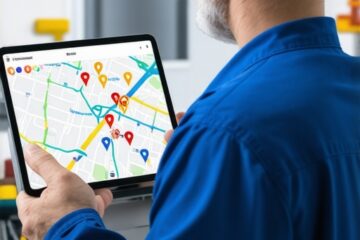
Proximity is the #1 ranking factor, but it’s also the most misunderstood. You cannot change where your office is located, but you can change how Google perceives your reach. Many contractors try to “game” this by using fake addresses or P.O. boxes, which is a fast track to a permanent suspension. Instead, savvy business owners use a google maps ranking service to visualize their “ranking radius.” If you don’t know exactly where your visibility drops off, you are flying blind. You might be dominating the three blocks around your shop while being completely invisible to the high-value neighborhoods just five miles away.
The “Ghosting” Effect: Why You’re Filtered Out of the Detroit Map Pack
Have you ever searched for your service and noticed that a competitor who is further away than you is ranking, while you are nowhere to be found? This is likely due to “Profile Filtering.”
Google hates redundancy. If there are multiple businesses in the same category located in close proximity – such as a professional building in Birmingham or a shared warehouse space in Eastern Market – Google will often “filter out” what it perceives as the weaker profile. They only want to show the “best” version of that service in that specific micro-location. If your profile isn’t technically superior, you get “ghosted.”
This filtering is getting even stricter. As we look toward the future, the how the 2026 Google Maps update changes everything for Detroit service pros, we see a shift toward AI-driven neighborhood-level filtering. Google is moving away from broad city-wide rankings and toward hyper-local relevance. If you are located on a busy corridor like Woodward Avenue, you are likely competing with dozens of other contractors. We’ve explored why your shop disappears from the map when you cross Woodward Avenue, and it often comes down to this algorithmic filtering. If you aren’t the “alpha” profile in your immediate vicinity, you won’t even get a chance to compete for the rest of the city.
Why Five-Star Reviews Aren’t the “Silver Bullet” Anymore
“But Seth, I have a 4.9-rating and my competitor has a 4.2! Why are they above me?”
I hear this constantly. While reviews are a vital conversion factor (they help people decide to call you once they find you), they are not the primary ranking factor they once were. In fact, research shows that competitors with zero reviews sometimes rank higher than established businesses because of better technical optimization and relevance signals.
Google’s algorithm is looking for “behavioral signals” and “relevance.” If a user searches for “emergency basement waterproofing Detroit” and your profile just says “General Contractor,” Google will pass you over for the guy with three reviews who has “basement waterproofing” as his primary category and mentions it five times in his service descriptions. We go into deep detail on this in our post on why five-star reviews aren’t fixing your Detroit map rank. Reviews are the social proof, but technical SEO is the engine that gets you to the front of the line.
The Technical “Leaky Bucket”: Citations and NAP Consistency
If your business information is inconsistent across the web, Google loses trust in your location. This is the “Technical Leaky Bucket.” You’re pouring money into marketing, but the leads are leaking out because your data is a mess. This is where google business profile seo becomes a technical game.
NAP stands for Name, Address, and Phone number. In Detroit, we have unique challenges with this. Are you in “Detroit,” or are you in “West Bloomfield”? Does your old address from that shop you moved out of three years ago still appear on an old YellowPages listing? Even slight variations like “St.” vs “Street” or using a tracking number on one site and your main line on another can confuse the algorithm.
Inconsistent citations tell Google that you might not be a legitimate, stable business. For Michigan contractors, there are 6 specific citation mistakes killing your local search visibility that I see daily. From failing to claim local Bing and Apple Maps listings to ignoring niche-specific directories for trades, these errors act as an anchor on your rankings. To fix this, you need to use local seo tools to audit your footprint and force-sync your data across the ecosystem.
Optimization for the “Service Area Business” (SAB) Model
Most local seo for contractors strategies fail because they treat a service-based business like a retail store. If you are a plumber, you don’t want people coming to your house; you go to theirs. This makes you a Service Area Business (SAB) in Google’s eyes.
The biggest mistake SABs make is thinking that selecting “Detroit, Dearborn, and Pontiac” in their service area settings will actually make them rank in those cities. It won’t. That setting is merely a visual boundary for users; it carries almost zero weight in the ranking algorithm. To rank in a city where you don’t have a physical office, you need geo-targeted content and localized signals.
Effective google business profile optimization for an SAB requires showing Google *proof* of where you work. This means uploading photos that are geotagged to the neighborhoods you serve – like Corktown, Midtown, or Palmer Park. It means mentioning these areas in your updates and responding to reviews by mentioning the specific neighborhood where the job took place. If you aren’t providing this “proof of service,” Google will default to only showing you to people within a few miles of your registered home or office address.
3 Immediate Fixes to Boost Your Detroit Map Visibility
If you are tired of the silence, you don’t need a year-long strategy to start seeing movement. Here are three immediate technical fixes you can implement today to rank higher on google maps.
1. Primary Category Audit
This is the single most important setting on your profile. Many Detroit contractors select “Contractor” as their primary category. That is too broad. If you are a roofer, your primary category must be “Roofing Contractor.” If you do HVAC, it should be “HVAC Contractor.” Google prioritizes the primary category above all else when matching search intent. Check your competitors; if they are outranking you, look at what their primary category is. You can use google business profile seo tools to see hidden categories that your competitors might be using to steal your leads.
2. Hyperlocal Content Strategy
Stop posting generic “Happy Monday” updates on your profile. Nobody cares. Instead, post about the specific work you are doing in Detroit neighborhoods. “Just finished a full roof replacement in the Boston-Edison district! Dealing with these historic homes requires a special touch.” This tells Google’s AI that you are active and relevant in a specific geographic location. As research from Today@Wayne suggests, small businesses power Detroit’s economy, but the digital divide – including poor SEO – often keeps them hidden. Closing that divide starts with proving your local presence through content.
3. Visual Verification and Geo-Tagging
Google is making a major shift toward verifying that businesses are actually where they say they are. Contractors need to show local reputation in a way AI search can verify. When you take a photo of a job site, ensure your location services are on. When you upload that photo to your profile, Google reads the metadata. If you have 50 photos from jobs in Birmingham and zero from Detroit, don’t be surprised when you don’t rank for “Detroit contractor” searches. Use google maps lead generation tools to track how these photos impact your search radius over time.
Taking Back the Motor City SERPs
The “Zero Call” problem isn’t a mystery; it’s a diagnosis. In the vast majority of cases, Detroit contractors are being held back by a combination of proximity traps, profile filtering, and a “leaky bucket” of inconsistent technical signals. Google is not trying to hide you; it’s simply trying to find the most “trusted” and “proximate” answer for its users.
In a city as competitive as Detroit, you cannot rely on luck. You need to understand that city borders don’t always match search intent; proximity weights results for every individual searcher. If you want to dominate the Map Pack, you have to be more than just a good contractor – you have to be a dominant digital entity. You have to prove to the algorithm that you are the most relevant, most trusted, and most active provider in the neighborhoods that matter to your bottom line.
Are you ready to stop being a ghost on the map? It’s time to stop guessing and start optimizing. Whether you’re looking to fix a specific ranking issue or you want a total overhaul of your local presence, the path to more calls starts with a technical audit. Don’t let your competitors in the suburbs steal the leads that should be yours in the city. Perform a local seo audit today or reach out to us at RankRight to start taking back your territory on the Detroit SERPs.