Why Mismatched Address Details Are Quietly Killing Your Detroit Rankings
The Silent Erosion of Detroit Local Authority
In the world of Detroit search engine optimization, it’s rarely the big, obvious mistakes that sink a campaign. It isn’t always a lack of reviews or a missing website. More often, it is the “silent killer”: mismatched address details. As a technical SEO strategist with over seven years in the trenches, I have seen dozens of businesses in the Motor City wonder why they can’t break into the Top 3 Map Pack despite having a beautiful storefront and a 4.9-star rating. The answer almost always lies in the integrity of their NAP – Name, Address, and Phone number.
Google’s local algorithm is essentially a “trust engine.” Before it recommends your business to a potential customer standing on Woodward Avenue, it needs to be 100% certain that you are where you say you are. If your website lists your location as “123 Woodward Ave,” but your Yelp profile says “123 Woodward Avenue, Suite 2,” and your Facebook page omits the suite number entirely, that trust erodes. To an algorithm, these are not just minor typos; they are conflicting data points that suggest unreliability.
In Detroit, geography is everything. The moment a customer crosses 8 Mile or turns off Jefferson Ave, the proximity signals sent to Google change. If your address data is inconsistent, Google’s confidence in your physical location wavers. This is why why your Detroit shop disappears the moment a customer parks down the street. When the algorithm cannot verify your exact coordinates across the web, it defaults to a safer bet – your competitor who has perfectly synchronized data.
How the Google Algorithm Interprets Address Data
To understand why address consistency is vital, we have to look at the three pillars of local search: Proximity, Relevance, and Prominence. While you cannot control proximity (where the user is standing), you can heavily influence relevance and prominence through high-quality google business profile ranking strategies. However, address discrepancies act as a “relevance dampener.”
Research from industry leaders like Rocket Clicks has shown that even slight discrepancies confuse the “neural matching” components of Google’s algorithm. This confusion leads to what we call “Profile Filtering.” If Google’s crawlers find three different versions of your address, the algorithm may decide to filter your listing out of the Map Pack entirely to avoid providing a poor user experience. It would rather show a business that is further away but has verified, consistent data than a nearby business with “fuzzy” location details.
This is a technical hurdle that requires a deep Detroit local SEO checklist to overcome. When the algorithm isn’t 100% sure where you are, it won’t show you in the competitive Top 3. It’s not just about being on the map; it’s about being the most “trusted” pin on that map.
The Detroit Map Pin Problem: Neighborhoods vs. Zip Codes
Detroit presents a unique challenge for local SEO because our neighborhood identities – Corktown, Midtown, Eastern Market, the Villages – often carry more weight with locals than the actual zip codes. However, Google’s “Map Pin” logic is strictly mathematical. A business located on the border of Midtown and New Center might have a physical zip code that doesn’t align with the “perceived” location of its target audience.
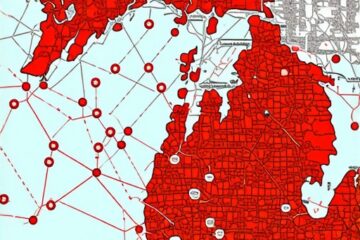
Mismatched addresses can cause a phenomenon known as “pin drift.” This happens when third-party directories (citations) use slightly different coordinates than your Google Business Profile (GBP). If your Yelp pin is 50 feet away from your GBP pin because one used the street address and the other used a suite-specific entrance, Google may struggle to aggregate your “prominence” scores. You effectively become two different, weaker entities in the eyes of the AI. Using professional local seo tools can help you identify where these pins are drifting.
I often consult with businesses that find their search visibility drops off a cliff once they move just a few blocks. Often, the issue isn’t the move itself, but the quick fix for Detroit business pins stuck in the wrong zip code that was never implemented across their entire digital footprint. Consistency across neighborhoods is the only way to maintain authority in a city as geographically diverse as ours.
Common Formatting Errors Killing Your Michigan Citations
It’s the “micro-errors” that usually do the most damage. I’m talking about “St.” vs. “Street,” “Ste” vs. “Suite,” or even the way you format your phone number. While Google has become better at understanding that “St.” and “Street” are the same, the sheer volume of these variations across hundreds of directories can still dilute your ranking power. This is especially true when it comes to understanding Michigan citation building, where local directories may have outdated formatting standards.
Another major pitfall is the use of call-tracking numbers. Recent Reddit SEO research and discussions among local experts have highlighted a dangerous trend: businesses using different tracking numbers on different directories to measure ROI. While data is great, changing your primary business line across citations can hurt local search rankings more than the value of the tracking data itself. Google sees a different phone number and assumes the business has changed hands or closed.
These are the formatting errors quietly killing your Michigan citation value. As “SEO Jesus” famously noted, while “bargain backlinks” can sometimes rank a local business in a matter of days, those rankings are fragile and will inevitably collapse if the underlying NAP data is messy. You cannot build a skyscraper on a foundation of sand, and you cannot build a #1 ranking on inconsistent citations.
Step-by-Step: Auditing Your Detroit NAP Footprint
If you suspect your rankings are suffering from address issues, you need a systematic approach to cleaning up your data. This is a core component of any google maps ranking service. Follow these steps to reclaim your local authority:
- Identify Your “Golden Record”: This is your definitive address. It should be exactly as it appears on your utility bills, official business registration, or USPS records. Pick one format (e.g., 1234 Woodward Ave, Ste 100) and stick to it religiously.
- Run a Local Audit: Use a specialized tool to scan the web for every mention of your business. Look for variations in your name, old phone numbers, or addresses from previous locations.
- Sync the “Big Four” Aggregators: Most local data flows from four major providers (Data Axle, Neustar Localeze, etc.). If these are wrong, the rest of the web will eventually be wrong too.
- Clean Up Unstructured Citations: These are mentions of your business on blogs, news sites, or local Detroit chamber of commerce pages. These require manual outreach but are vital for advanced Google Business Profile strategies for Detroit.
By conducting a thorough local seo audit, you ensure that every signal pointing to your business is reinforcing the same physical location. This clarity allows Google to confidently place your pin at the top of the Map Pack when a Detroiter searches for your services.
Preparing for the 2026 Local Search Algorithm Shift
As we look toward 2026, the importance of hyper-precise address data is only going to increase. We are moving away from traditional “search” and toward “AI-driven recommendation.” AI assistants like Siri, Alexa, and Google’s Gemini are becoming the primary way people find local services. When a user asks, “Find a mechanic near me,” the AI doesn’t just look for a high-ranking site; it looks for a verified entity.
If an AI cannot verify your location across at least three high-authority sources with 100% accuracy, it simply won’t recommend you. The risk of sending a user to a wrong address is too high for the AI’s reputation. This makes preparing your Detroit shop for the 2026 local search algorithm shift a matter of data hygiene. Precision is the new currency of SEO.
Focusing on optimizing for the Detroit map pack today means securing your spot in the voice-activated world of tomorrow. The businesses that survive the next algorithm shift will be those that treated their address data as a critical technical asset, not just a line of text on a contact page.
Conclusion & Call to Action
Mismatched address details are the silent killers of Detroit rankings, but they don’t have to be the end of your digital presence. By auditing your NAP footprint and ensuring absolute consistency across the web, you can rebuild Google’s trust and climb back into the Map Pack. Don’t let a “St.” vs “Street” discrepancy stand between you and your customers.
To truly how to dominate local search in Detroit, you need the right technology. I recommend you visit SEO Viper to use their local seo software for automated tracking and citation cleanup. It is time to stop guessing and start winning. Take control of your data today and rank higher on google maps tomorrow.